
Sorry, but your login has failed. Please recheck your login information and resubmit. If your subscription has expired, renew here.
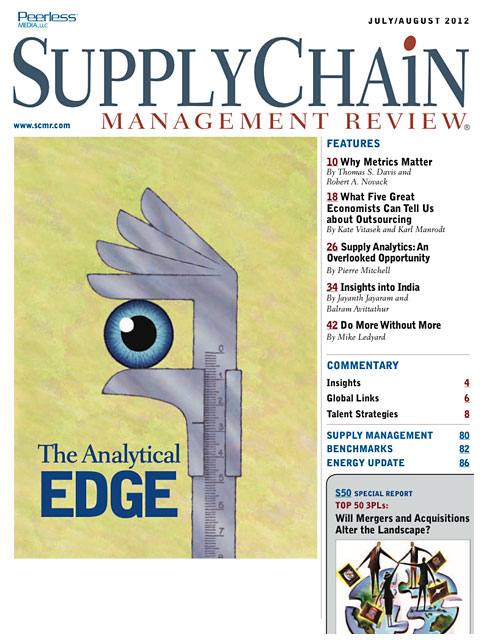
July-August 2012
Managers sometimes don’t understand the importance of the information provided by supply chain metrics—or even the need for metrics in the first place. But according to researchers from Penn State, having timely and accurate metrics in place leads directly to superior business performance. They make a strong case for why supply chain metrics really do matter. Browse this issue archive.Need Help? Contact customer service 847-559-7581 More options
A modern highway infrastructure, tracking technologies like Global Positioning System (GPS), techniques such as cross docking, and state-of-the-art container ports have all become the norm for supply chains in the developed world. They are far from the norm, however, in the lesser developed countries of the world. For multinational companies that are doing business—or that want to do business—in these countries, it is vital to understand the supply chain gaps and challenges.
The focus of this article is on supply chain conditions in one emerging economy that has enormous long-term growth opportunity: India. In addition to a rapidly growing market, India possesses a workforce that is considerably younger and larger than more developed regions like Europe and North America. These factors have prompted multinationals to seriously consider India both as a source for manufacturing and as a market for their goods.
Yet doing business in India brings its own set of challenges— a slow and cumbersome bureaucracy, infrastructural constraints such as shortages in electricity and skilled labor, and road and port congestion, among them. With respect to supply chains, what may be taken for granted in developed economies is often the exception rather than the rule in India. Shipments by road that can be completed in three days in the U.S., for example, could take as long as nine days in India. Similarly, ships can wait up to five days to dock at an Indian port, compared to little or no wait time in Europe. Further, there are few logistics firms in India with a fleet size larger than 100 trucks. Moreover, very few trucks are fitted with a GPS tracking device, thereby preventing any real-time tracking of shipments.
 |
This complete article is available to subscribers
only. Click on Log In Now at the top of this article for full access. Or, Start your PLUS+ subscription for instant access. |
Not ready to subscribe, but need this article?
Buy the complete article now. Only $20.00. Instant PDF Download.
Access the complete issue of Supply Chain Management Review magazine featuring
this article including every word, chart and table exactly as it appeared in the magazine.
SC
MR
Sorry, but your login has failed. Please recheck your login information and resubmit. If your subscription has expired, renew here.
July-August 2012
Managers sometimes don’t understand the importance of the information provided by supply chain metrics—or even the need for metrics in the first place. But according to researchers from Penn State, having timely… Browse this issue archive. Access your online digital edition. Download a PDF file of the July-August 2012 issue.|
|
Download Article PDF |
A modern highway infrastructure, tracking technologies like Global Positioning System (GPS), techniques such as cross docking, and state-of-the-art container ports have all become the norm for supply chains in the developed world. They are far from the norm, however, in the lesser developed countries of the world. For multinational companies that are doing business—or that want to do business—in these countries, it is vital to understand the supply chain gaps and challenges.
The focus of this article is on supply chain conditions in one emerging economy that has enormous long-term growth opportunity: India. In addition to a rapidly growing market, India possesses a workforce that is considerably younger and larger than more developed regions like Europe and North America. These factors have prompted multinationals to seriously consider India both as a source for manufacturing and as a market for their goods.
Yet doing business in India brings its own set of challenges— a slow and cumbersome bureaucracy, infrastructural constraints such as shortages in electricity and skilled labor, and road and port congestion, among them. With respect to supply chains, what may be taken for granted in developed economies is often the exception rather than the rule in India. Shipments by road that can be completed in three days in the U.S., for example, could take as long as nine days in India. Similarly, ships can wait up to five days to dock at an Indian port, compared to little or no wait time in Europe. Further, there are few logistics firms in India with a fleet size larger than 100 trucks. Moreover, very few trucks are fitted with a GPS tracking device, thereby preventing any real-time tracking of shipments.
|
|
SUBSCRIBERS: Click here to download PDF of the full article. |
SC
MR

Latest Supply Chain News
- Procurement’s Moneyball Moment: Connecting Strategy, Sourcing, and Supply Chain Reality
- AI won’t fix a broken supply chain foundation
- How I vibe-coded an S&OP app in 30 hours
- The AI regulation gap: Risk, cost, and competitive advantage
- PepsiCo moves its startup sustainability program from pilots to operational scale across Asia Pacific
- More News
Latest Resources

 Explore
Latest Supply Chain News
- PepsiCo moves its startup sustainability program from pilots to operational scale across Asia Pacific
- Eli Lilly’s Mar Gimeno to keynote at NextGen Supply Chain Conference 2026
- Agentic coding and the future of supply chain leadership
- From orbit to operations: Winning the race for the earliest disruption signal
- Stop moving boxes, start moving dollars: The new math of global supply chain velocity
- Finding your rhythm: SME supply chain footwork when the rules keep changing
- More latest news
Latest Resources

Subscribe
Supply Chain Management Review delivers the best industry content.

Editors’ Picks