
Sorry, but your login has failed. Please recheck your login information and resubmit. If your subscription has expired, renew here.
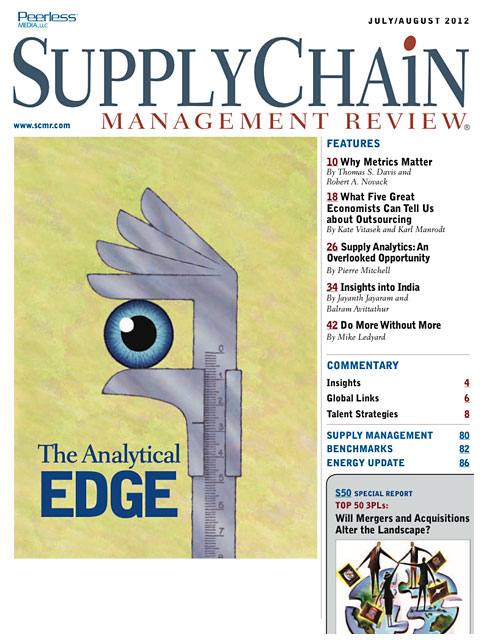
July-August 2012
Managers sometimes don’t understand the importance of the information provided by supply chain metrics—or even the need for metrics in the first place. But according to researchers from Penn State, having timely and accurate metrics in place leads directly to superior business performance. They make a strong case for why supply chain metrics really do matter. Browse this issue archive.Need Help? Contact customer service 847-559-7581 More options
A well-planned journey or expedition will have a plan, a budget, a map, and a compass. Before embarking, you should ask three fundamental questions:
1. Where do we want to go?
2. How do we get there?
3. How will we know when we have arrived?
After the trip is completed, you often reflect on the travel and the outcome. Did we reach the objective? Arrive on time? Stay on the budget? Travel efficiently? What should we do differently next time?
The same line of questioning should prevail when setting off on a business “journey”—whether it’s a limited expansion to a distribution center or a over-year strategic plan. Setting broad and special goals, determining strategic and tactical directions, and maximizing resources require at least three levels of planning in an organization—strategic planning, operational planning (S&OP), and production planning. Most organizations place great emphasis on the “hows and whys” of strategic planning and on S&OP (sales and operations planning). Much less attention is typically paid to metrics—how well are we doing against our goals and objectives set in the planning process. However, launching a business initiative without the right metrics is akin to starting on a real expedition without a compass. And without knowing where you are or how you’re doing, the default measure tends to be costs.
Managers often don’t understand the importance of the information provided by operational metrics or the significance of the metrics themselves. This article will explore the need for a well-structured operational metrics program and the value such a program can provide. Throughout our discussion, the term “metrics” will refer to operational metrics as opposed to financial metrics.
 |
This complete article is available to subscribers
only. Click on Log In Now at the top of this article for full access. Or, Start your PLUS+ subscription for instant access. |
Not ready to subscribe, but need this article?
Buy the complete article now. Only $20.00. Instant PDF Download.
Access the complete issue of Supply Chain Management Review magazine featuring
this article including every word, chart and table exactly as it appeared in the magazine.
SC
MR
Sorry, but your login has failed. Please recheck your login information and resubmit. If your subscription has expired, renew here.
July-August 2012
Managers sometimes don’t understand the importance of the information provided by supply chain metrics—or even the need for metrics in the first place. But according to researchers from Penn State, having timely… Browse this issue archive. Access your online digital edition. Download a PDF file of the July-August 2012 issue.|
|
Download Article PDF |
A well-planned journey or expedition will have a plan, a budget, a map, and a compass. Before embarking, you should ask three fundamental questions:
1. Where do we want to go?
2. How do we get there?
3. How will we know when we have arrived?
After the trip is completed, you often reflect on the travel and the outcome. Did we reach the objective? Arrive on time? Stay on the budget? Travel efficiently? What should we do differently next time?
The same line of questioning should prevail when setting off on a business “journey”—whether it’s a limited expansion to a distribution center or a over-year strategic plan. Setting broad and special goals, determining strategic and tactical directions, and maximizing resources require at least three levels of planning in an organization—strategic planning, operational planning (S&OP), and production planning. Most organizations place great emphasis on the “hows and whys” of strategic planning and on S&OP (sales and operations planning). Much less attention is typically paid to metrics—how well are we doing against our goals and objectives set in the planning process. However, launching a business initiative without the right metrics is akin to starting on a real expedition without a compass. And without knowing where you are or how you’re doing, the default measure tends to be costs.
Managers often don’t understand the importance of the information provided by operational metrics or the significance of the metrics themselves. This article will explore the need for a well-structured operational metrics program and the value such a program can provide. Throughout our discussion, the term “metrics” will refer to operational metrics as opposed to financial metrics.
|
|
SUBSCRIBERS: Click here to download PDF of the full article. |
SC
MR

Latest Supply Chain News
- The AI regulation gap: Risk, cost, and competitive advantage
- PepsiCo moves its startup sustainability program from pilots to operational scale across Asia Pacific
- Eli Lilly’s Mar Gimeno to keynote at NextGen Supply Chain Conference 2026
- Agentic coding and the future of supply chain leadership
- From orbit to operations: Winning the race for the earliest disruption signal
- More News
Latest Podcast

 Explore
Latest Supply Chain News
- PepsiCo moves its startup sustainability program from pilots to operational scale across Asia Pacific
- Eli Lilly’s Mar Gimeno to keynote at NextGen Supply Chain Conference 2026
- Agentic coding and the future of supply chain leadership
- From orbit to operations: Winning the race for the earliest disruption signal
- Stop moving boxes, start moving dollars: The new math of global supply chain velocity
- Finding your rhythm: SME supply chain footwork when the rules keep changing
- More latest news
Latest Resources
Subscribe
Supply Chain Management Review delivers the best industry content.

Editors’ Picks